Leaving Preschool — A Child's First Real Goodbye
Finishing kindergarten, nursery or preschool is the first big break most children experience. They leave a place they attended for years, and the rhythm of daily life changes with it.
The date differs by country: in Japan the school year ends in March and preschools hold a formal graduation ceremony, while in much of Europe and North America the final day falls in early summer, sometimes with a small pre-K graduation and sometimes with nothing more than a last-day party. The ceremony is optional. The transition is not.
Note: Figmee currently offers figurine-style image generation and downloads of 3D model data (GLB / 3MF). Ordering a physical 3D print is Coming Soon.
The Usual Keepsakes, and What Each One Preserves
Costs below are Japanese market references, shown for scale; providers where you live will differ.
| Keepsake | Rough cost | What it does well | What to watch |
|---|---|---|---|
| Graduation album | Arranged by the school (3,000–10,000 yen) | Covers group photos and events comprehensively | The child's own expression does not appear |
| Studio portrait session | 10,000–30,000 yen | Consistently polished results | Both the clothes and the expression end up in "best behaviour" mode |
| Hand or foot print plaque | 1,000–5,000 yen | Records physical size at that moment | Says nothing about who they were becoming |
| Message book from the class | Arranged by the school | Preserves friends' words | Paper, so it degrades over time |
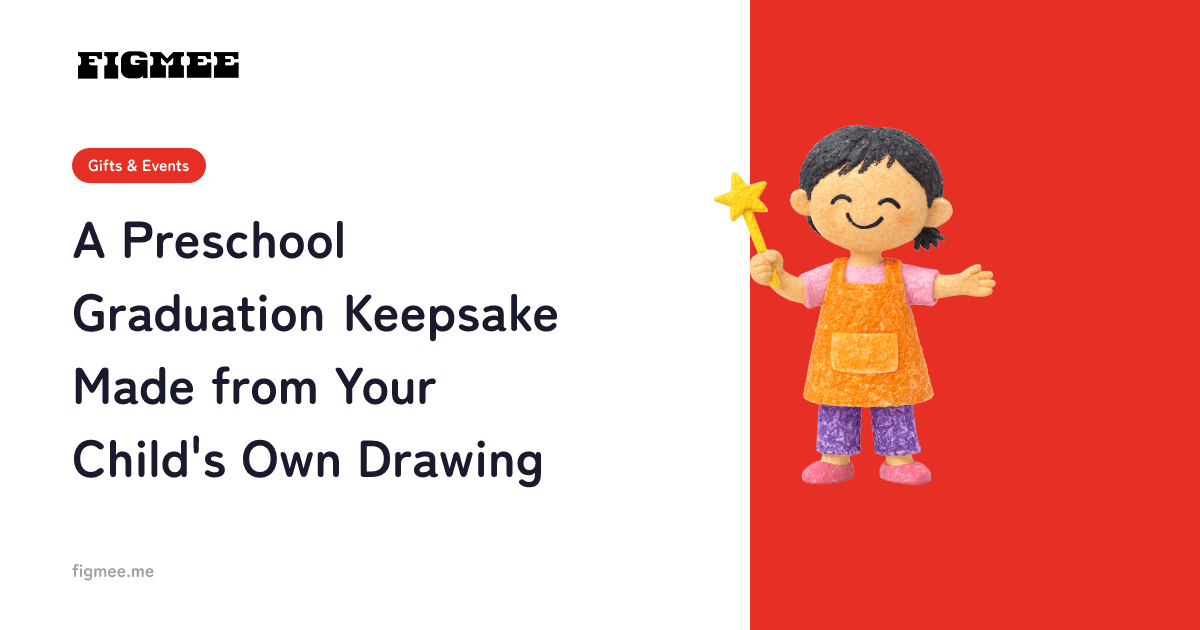
| Figurine-style 3D model from a drawing | Free tier available (see below) | Preserves the child's own expression | The result depends on the state of the original drawing |
You do not have to pick just one. Schools usually take care of the album and the photos, so what a family can usefully add is the thing only this child could have made.
Why the Final-Year Drawings Are Special
The art educator Viktor Lowenfeld described children's drawing as moving from a preschematic stage (roughly 4–7) into a schematic stage (roughly 7–9) (source: Japan Art Education Association journal, vol. 40).
A five- or six-year-old leaving preschool is at the far end of the preschematic stage. Figures have become stable, but nothing is yet constrained by a ground line or rules of perspective. Fish swim in the sky; a mother stands taller than the house. That freedom quietly disappears once school starts teaching how to draw. Understanding the stages of children's drawing covers the changes age by age.
Which Drawing to Choose
- The final class project. Work made at the school. It is often returned after the display, but not always — photograph it while it is still on the wall.
- Something from the back of the sketchbook. Drawings made with nobody directing them.
- "Draw the best thing about this year." A single piece requested before the last day, so the memory comes attached.
- A drawing of a friend or teacher. Pieces with a person as the subject read strongly in three dimensions.
How to choose the right drawing sets out the selection criteria.
A Countdown Plan
| When | What to do |
|---|---|
| About 6 weeks before the last day | Choose the drawing, or ask for one |
| About 4 weeks before | Photograph it and generate the figurine-style image |
| About 3 weeks before | Check the result and generate the 3D model data |
| The final week | Have prints and share links ready |
Work displayed at the school is sometimes only handed back on the last day itself. Do not wait for it to come home — photograph it while it is on display.
Steps and Cost
- Lay the drawing flat and photograph it from directly above in a well-lit room
- Upload it to Figmee and generate the figurine-style image
- Check the result and generate the 3D model data (GLB / 3MF)
When you register, the first 5 figurine-style image generations are free (valid for 3 months from registration, first registration per email address only). 3D model data generation costs 5 credits, and credits start at 550 yen for 5. See the Figmee pricing explainer for detail, and how to photograph a child's drawing well to avoid the common mistakes.
If You Are Giving One to a Teacher or a Friend
Giving something to the class teacher at the end of the year is a common idea. Two or three checks make it comfortable.
- Is any part of the drawing by another child? Collaborative work carries other children's rights too.
- Are name tags, the school's name or an address visible? Especially worth checking if it may end up on social media.
- What is the school's policy? Some have rules about photographing or removing displayed work.
Frequently Asked Questions
Q. Our final project is a three-dimensional craft rather than a drawing. Can it still be used?
A. The conversion works from a photograph taken straight on, not from the object itself. There are limits to how much depth is reproduced, so a flat drawing generally gives a result closer to what you expect.
Summary
Leaving preschool is the last moment you get to see how this child drew as a small child. Add the one thing albums and photographs do not cover — their own expression. For the wider occasion, see Turning graduation memories into something you keep and Building a growth collection across the preschool years; for what comes next, A school-entrance keepsake made from a child's drawing.