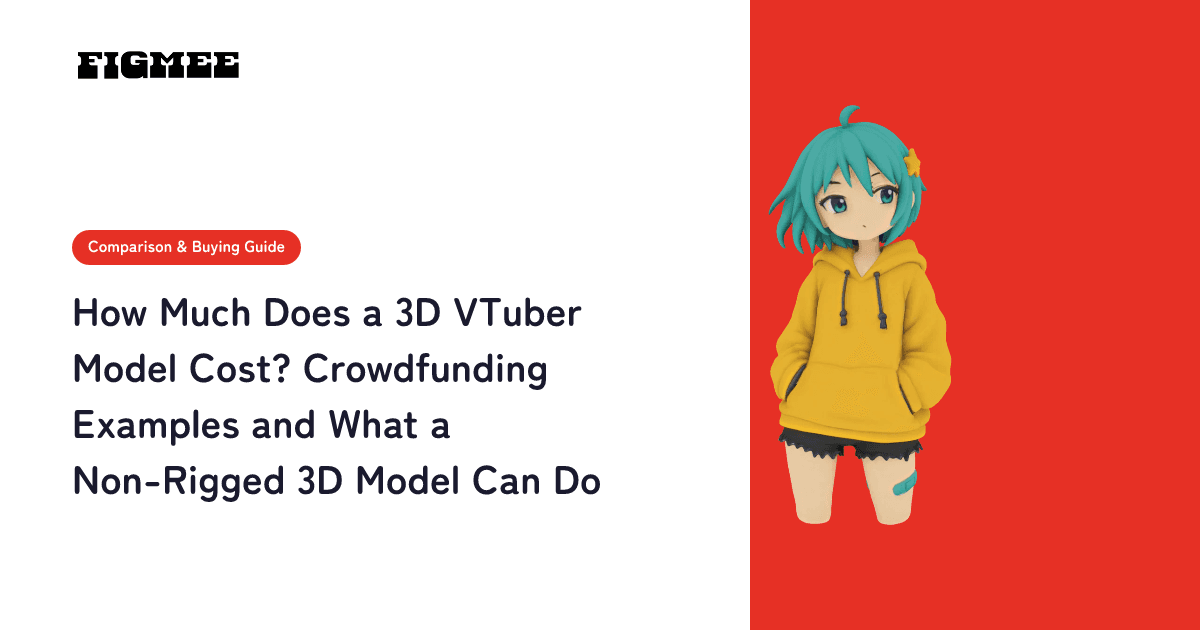
A custom 3D VTuber model that you can actually stream with costs $300–800 at the basic tier, $800–2,500 at the mid tier, and $3,000–10,000+ for pro work, according to a 2026 English-language pricing guide. Japanese price guides add a separate option fee for the complex motion a VTuber model needs, a fee that on its own sits at the top of their 3D modeling ranges, and some independent VTubers in Japan have funded their 3D debut through crowdfunding.
A 3D model you don't stream with is a different thing. A static model, shape and color only, that you spin in a browser can be generated with AI from a single character illustration. But it is not a VRM file and has no rig (skeleton), so it can't move on stream. This article covers what a 3D VTuber model costs and why, real crowdfunding examples, and then draws a clear line between what a non-rigged 3D model can and can't do.
Note: Figmee currently provides figurine-style images made from illustrations, 3D model data (GLB / 3MF), and turntable videos of your 3D models. Ordering physical 3D prints is Coming Soon, and when it launches, shipping will be limited to Japan. Photos, such as photos of real people, can't be turned into 3D.
How much does a 3D VTuber model cost?
A stream-ready 3D VTuber model typically runs from a few hundred dollars at the basic tier to several thousand dollars or more for professional work. Japanese guides likewise list an option fee for the complex motion a VTuber model needs, such as folding arms, crouching, or dancing, on top of the modeling cost, because every stage needed for movement adds to the price. A static 3D model on Figmee costs 5 tokens ($5.99 for 5 tokens), and the first model on each account is free.
| What you get | Price level | Source |
|---|---|---|
| 3D VRM model, Basic tier | $300–800 | VIVERSE, "VTuber Model Pricing in 2026", May 28, 2026 |
| 3D VRM model, Mid tier | $800–2,500 | Same as above |
| 3D VRM model, Pro tier | $3,000–10,000+ | Same as above |
| Option fee for the complex motion needed for VTuber use, such as folding arms, crouching, or dancing (Japan) | Very high on its own, charged separately from modeling | Crowdsourcing Times, "Market rates for 3D modeling", updated June 2, 2025, in Japanese |
| 3D modeling of a humanoid character (Japan) | Moderate to very high | Same as above |
| Rigging (adding a skeleton) (Japan) | Moderate to fairly high, sometimes lower | Same as above |
| Animation (Japan) | Simple motion: moderate; complex motion: high | Same as above |
| Static 3D model you don't stream with (Figmee) | 5 tokens per model ($5.99 for 5 tokens); first model free on each account | As of November 2026. Tokens come back automatically if a generation fails |
On a Japanese Q&A site, one person answering the question "How much does a VTuber model cost?" described custom models as ranging from high to very high, with a VRoid-based model being much cheaper (Yahoo! Chiebukuro answer, July 25, 2024, in Japanese). That is one person's view, not a market survey. All of these figures are guides from the time each source was published and change a lot with the provider, the number of outfits and expressions, and the number of revisions. For a comparison of character 3D costs by provider and production stage, see Comparing the Cost of Turning Your Character into 3D.
Why are 3D VTuber models so expensive?
Because a model you stream with isn't finished once the shape is built. It needs a skeleton so the body can move (rigging), facial expressions and mouth movement, and support for a format your streaming software can load, and each stage adds cost.
| Stage | What it involves | Needed to move on stream? |
|---|---|---|
| Modeling | Building the 3D shape | Yes |
| Texturing | Applying color, patterns, and surface detail | Yes |
| Rigging | Adding a skeleton so the model can move | Yes |
| Expression setup | Blinking, mouth movement, and switching expressions | Yes |
| Format support | Exporting to VRM (a 3D avatar format for VR) and similar | Depends on your streaming software and services |
| Debut preparation | Staging a 3D live show or debut stream | Optional |
VRM is defined by the VRM Consortium as "a 3D avatar file format for VR" (source: VRM official site). For how rigging works, see What Is Rigging?
You can also try building one yourself, but the same Japanese Q&A answer warned that an amateur build "will definitely end up with creepy movement or a creepy face, and viewers will leave" (our translation). Whether DIY works for you depends on your skills, but keep in mind that a moving 3D model requires tuning the motion as well as the shape, and any visual glitches show up live on stream.
What are some real examples of VTubers crowdfunding their 3D debut?
Independent VTubers in Japan often raise the money for a 3D model through crowdfunding. In the reports and press releases we could verify, some projects reached their goal within 15 minutes or about 27 hours of launch, and others raised close to double their goal.
| VTuber | When and where | Purpose | Result | Source |
|---|---|---|---|---|
| Aoba Ria | Launched January 5, 2026, on V-Sai | Making a 3D model | Reached the goal 15 minutes after launch | Digital Gear press release, February 5, 2026, in Japanese |
| Sakura Rina | Launched November 25, 2025, on V-Sai | Making a 3D model and holding a debut live show | Reached the goal in about 27 hours | Digital Gear press release, December 29, 2025, in Japanese |
| Takanashi Kobato | September 2023 | 3D production | Raised a sizable total; the 3D debut live show on February 16, 2025, was reported to have a large budget of its own | Dengeki Online, February 14, 2025, in Japanese |
| Takehana Note | From March 2019, on Makuake | 3D debut | Raised nearly twice the goal | Mogura VR, "VTuber crowdfunding case studies," July 27, 2019, in Japanese |
| Mimic | October 2019 | Making a new 3D model | About a fifth of the goal raised by the time the article was published | Mogura VR, October 31, 2019, in Japanese |
A crowdfunding goal isn't necessarily the price of the 3D model itself. As Sakura Rina's project shows, it can include the cost of a debut live show, and rewards and platform fees also come out of it, so don't read a goal as the going rate for a 3D model.
These reports and releases present reaching the goal and the debut show as milestones in a VTuber's career. A 3D debut, big price tag included, seems to be treated as something fans celebrate together. That is exactly why an AI-generated static 3D model can't stand in for a 3D debut. The next section covers what it can do instead.
What can a static, non-rigged 3D model do?
From one character illustration, you can make a 3D model you can rotate 360° in a browser (shape and color data) and a short video of it turning. It's useful for checking how your character looks in 3D before you commission a model, making material for announcements and posts, and giving your character designer or a modeler something concrete to discuss.
| Use | What you use | Things to watch |
|---|---|---|
| Check how the character looks in 3D before commissioning | A 3D model you can rotate 360° in the browser | The AI guesses at the back where the illustration shows nothing. This is not the same as a commissioned model |
| Use it in announcements and social posts | Turntable video (about 6 seconds, two turns, square, no tokens needed) | The Figmee logo sits in the bottom right corner and can't be removed. The format is MP4 or WebM |
| Use it as material for a stream waiting screen or thumbnail | Turntable video or 3D image | You're just playing a video or showing an image; the character doesn't move during the stream |
| Show your designer or a modeler the kind of depth you want | 3D model or turntable video | Whether the generated data can be used as a working base depends on their workflow |
| Make illustration material in other poses | Figurine-style images in new poses, made after registering the character | Figmee tries to keep the look the same, but results may not always match your design |
Here's how to make one on Figmee:
- Check with your character designer (a day or more, including waiting for a reply): Ask whether you may turn the art into 3D, whether you may use an AI service, and where you'll post it (more on this below).
- Pick one illustration (about 10 minutes): Prepare a full-body image as PNG, JPEG, or WebP (up to 20 MB). Live2D model data can't be used as-is, so export the original character art as a single image.
- Generate a 3D image (about 2 minutes of hands-on time): Choose a quality level, "Standard", "Pro", or "Max", and generate. It uses 1 to 3 tokens.
- Generate the 3D model (about 1 minute of hands-on time): This uses 5 tokens, and the first model on each account is free. Rotate it 360° to check the side and back.
- Export a turntable video (about 3 minutes): Use "Create 360° video" on the work page. It works in Chrome and Edge on a computer and in Chrome on Android; it may not work in Safari or Firefox.
Waiting time for generation varies with how busy the service is. If an image is judged to be a photo, generation stops and the tokens are returned automatically.
What can't a static 3D model do?
A 3D model made with Figmee is not meant for moving your character on stream. You can save it in two formats, GLB and 3MF; VRM and FBX aren't available, and rigging and animation aren't supported. The 3D model is static shape-and-color data (Figmee Help, "What Figmee can't do").
| What you want to do | Figmee's 3D | What you'd need |
|---|---|---|
| Move the body and face on stream (tracking, expressions, mouth movement) | Not possible | Rigging and expression setup; commissioning a modeler is the realistic route |
| Export as VRM | Not possible (only GLB and 3MF) | Rigging first, then VRM conversion work |
| Use it as an avatar on VRChat or similar platforms | Not possible | A skeleton, weights, and each platform's setup |
| Hold a 3D debut live show | Not possible | A moving 3D model and live staging |
| Fix the shape or split it into parts | Not inside Figmee | Import the GLB into 3D software such as Blender and edit it there |
If you heard "3D model" and pictured your character moving on stream, this is the point to decide. If moving on stream is the goal, you need a modeler, not Figmee. For why a Live2D model doesn't convert directly to 3D, see Why Can't You Convert a Live2D Model to 3D?
What should you check with your character designer?
Before anything else, tell the person who designed your character art (your "mama" in Japanese VTuber terms) that you want to make a 3D version, that you'll use an AI service, and where you'll post it, and get their agreement. When you commission art, paying for it doesn't by itself transfer the copyright; as a rule, it stays with the artist, and turning the art into 3D can count as adapting it.
Under Japan's Copyright Act, even when a contract transfers the copyright, Article 27 rights (including adaptation) and Article 28 rights (rights in derivative works) are presumed to stay with the person who transferred it unless the contract names them (source: Japan's Agency for Cultural Affairs, FAQ on legal issues in arts and culture activities, Q5-4, in Japanese). Copyright rules differ by country, so if your commission falls under another country's law, check that law. If you have a contract or the messages from when you commissioned the art, reread them to see whether 3D or three-dimensional use is mentioned.
When you ask, spelling out these five points keeps everyone on the same page:
- What you'll make: a 3D model made from the character art that does not move on stream, plus a turntable video
- How: by uploading the art to an AI service (Figmee)
- Where it will appear: announcements on X, your stream waiting screen, Figmee's gallery, and so on
- Money: whether it will be used for anything paid, such as merch
- Attribution: how you'll name the designer and how you'll note that AI was used
Sample message: "I'd like to turn my character art into a 3D model with an AI service and use a turntable video of it in announcements on X. It won't move on stream, and I won't use it for paid merch. Would that be OK with you?"
If you belong to an agency, check its rules as well. You may upload to Figmee only art you drew yourself or images you have permission to use from the rights holder. Uploaded images aren't used to train AI, and they aren't shown to anyone else unless you publish the work yourself. For checking the rights to your character art when making merch, see How to Make Your Own VTuber Acrylic Stand.
Frequently asked questions
Can I use a 3D model made with Figmee for streaming as a VTuber?
You can't make the character move on stream. Figmee's 3D models are static shape-and-color data with no rig. You can play the turntable video on a waiting screen or use it in announcements, but that's not the same as the character moving during a stream.
If I convert it to VRM, can I use it for streaming or on VRChat?
Changing the format alone won't work. To move as an avatar, the model needs to go through production work: adding a skeleton and adjusting how the mesh deforms with the body. Figmee saves GLB and 3MF files and doesn't support VRM. For how rigging works, see What Is Rigging?
Can I use an AI 3D model in announcements before my 3D debut?
With your designer's agreement, showing it as a preview of how the character looks in 3D is one option. If you do, label it as something like "an AI-made 3D preview" so people can tell it apart from a model that moves on stream. If viewers take it as your finished 3D debut, it could change what the real debut means to them.
Can it become physical merch?
Ordering physical 3D prints through Figmee is Coming Soon, so you can't order them yet (when it launches, shipping will be limited to Japan). The 3MF file you can download is meant for your own 3D printer or for printing services that accept 3MF.
Summary
A stream-ready 3D VTuber model costs $300–800 at the basic tier and $3,000–10,000+ for pro work in English-language pricing, and some independent VTubers in Japan have crowdfunded their 3D debut. It's expensive because a skeleton, expressions, and format support have to be built on top of the shape.
A 3D model you don't stream with can be generated with AI from one illustration and works well for checking how your character looks in 3D and for announcement material. But it's not a VRM file and has no rig, so it can't move your character on stream and can't replace a 3D debut. Whichever way you go, start by telling your character designer what you plan to do and getting their agreement.