
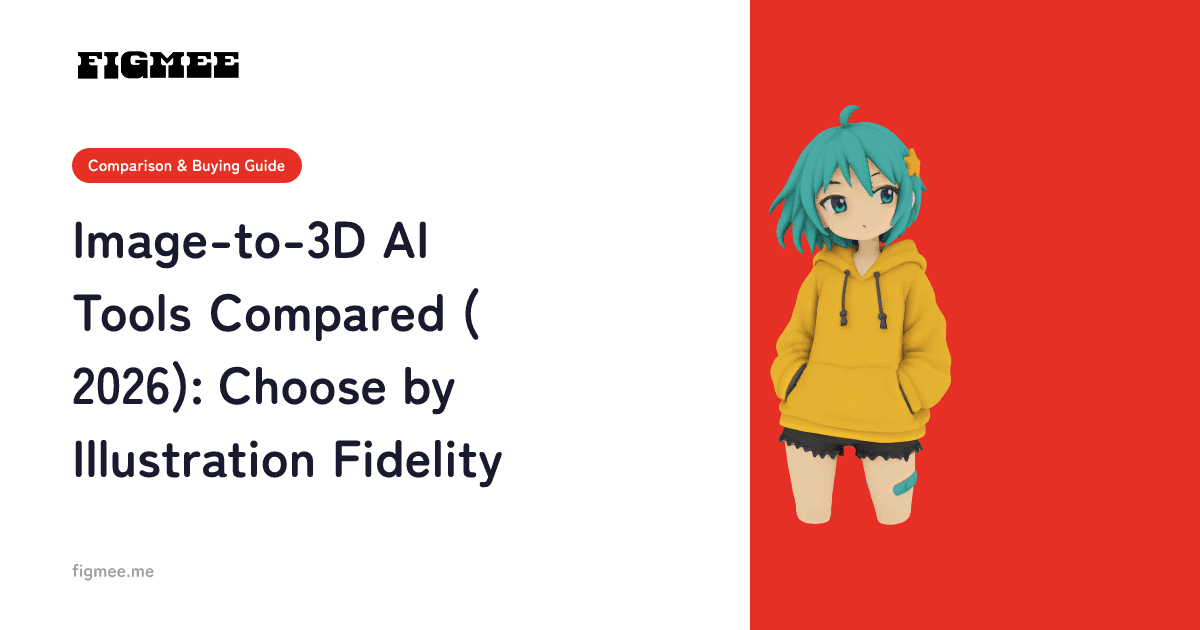
What are AI tools that turn an image into a 3D model?
An image-to-3D AI is a tool that generates 3D data (a mesh, meaning the 3D shape) automatically from a single photo or illustration you upload. Work that used to require specialist software and years of skill can now be done in minutes, right in your browser.
Here is the bottom line: choosing a tool by price or speed alone leads to regret. The right choice depends on your use case. Whether you want to mass-produce assets for games and apps, or turn your own drawn character into a display piece or print-ready data, the best tool differs. If your goal is to bring a hand-drawn illustration or original character into 3D, prioritize one axis above all: how faithfully the tool reproduces the lines and forms of your original art.
Note: Figmee currently offers figurine-style image generation and 3D model data (GLB / 3MF) downloads. Physical 3D print ordering is Coming Soon.
Five axes for choosing without regret
Before you read the table, decide what matters most to you. Think in these five axes.
1. Fidelity to illustrations and hand-drawn lines
This is where tools differ the most. Every tool is fairly good at turning real people or objects into 3D, but the precision of turning hand-drawn lines, stylized shapes, and flat illustrations into 3D varies widely. General image-to-3D tools are built around the idea of "scanning a photo into a solid," so line art or anime-style coloring can collapse in shape or gain unintended thickness. If you want to keep the feel of the hand-drawn line, a tool designed specifically for turning illustrations into 3D is a better fit. For the underlying approach, see our complete guide to turning illustrations into figurine-style 3D.
2. Language support and ease of use
Many tools from overseas have mostly English interfaces, and if you are not used to 3D terms (mesh, topology, retopology), you can stumble at the very first step. The less 3D knowledge you have, the more you should check for interface and support in your language, and how few steps it takes to go from upload to output.
3. Price and free tier
Most tools combine a monthly subscription with a "credit" system. Always check on the official site how many credits one generation consumes and how many models you can make on the free tier alone. Equally important is the license (usage rights). Some tools restrict free-tier output to "public, attribution required," so commercial-use terms must be checked separately from price.
4. Output format (GLB / 3MF, etc.)
What you plan to do with the model decides which file format you need. GLB is a versatile format that is easy to display on the web and use in game engines; 3MF and STL are for 3D printing; FBX and OBJ are for editing in 3D software. Check that the tool can export in a format your target software or service supports.
5. Use case (game / display / print)
Even for the same "3D model," game use prizes lightness (low polygon count), while display and print use prize visual fidelity and thickness. If your goal is to bring an original character into 3D to display at hand or keep as data, fidelity and output format are the deciding factors. For the flow of turning an original character into 3D, see how to turn an original character into 3D.
Main tools compared (as of July 2026)
We organized representative tools by the items in the five axes that can be verified objectively.
| Tool | What you can try for free | Paid guideline | Main output formats | Best for |
|---|---|---|---|---|
| Figmee | First 5 figurine-style image generations free after signup (valid 3 months from signup) | 3D model 550 JPY / model; images 550 JPY / 5 credits | GLB / 3MF | Turning illustrations and original characters into 3D; display and print-ready data |
| Meshy | 100 credits/month (a few models per month; output is CC BY 4.0 = attribution required) | Pro $20/month (1,000 credits) | GLB / FBX / OBJ / STL / USDZ / blend | Mass-producing assets for games and apps |
| Tripo Studio | 200 credits/month (up to 8 models; free tier is public under CC BY 4.0) | Pro $19.90/month (3,000 credits) | GLB / OBJ / GLTF, etc. (FBX on higher plans) | Quick prototyping; multi-format export |
| Rodin (Hyper3D) | Generating and redoing are free; charged on download ($1.50 per credit) | Creator $30/month (about 60 models as a guide) | GLB / FBX / OBJ / STL / USDZ, etc. | High-detail geometry; PBR textures |
| Luma (Genie line) | See official site (integrated into the Luma platform) | See official site | See official site | Prototyping 3D from text or images |
Information as of July 2026. Please check each official site for the latest details. Prices, free tiers, and licenses are subject to change.
Short reviews of each tool
Meshy
It can generate 3D from both text and images, and its range of output formats is a strength. It is easy to bring into game engines and 3D software, so it suits creators who want to produce assets in bulk. Free-tier output uses a CC BY 4.0 license (commercial use allowed with attribution); if you want exclusive rights, a paid plan is the prerequisite.
Tripo Studio
Generation is fast, and you can try several models even on the free tier, so it suits people who just want to give it a go. It exports in multiple formats, while free-plan output is public under CC BY 4.0, so check this against your use. Higher plans unlock private, commercial use and high-resolution textures.
Rodin (Hyper3D)
This is a tool focused on fine geometry and PBR (physically based material rendering). Generating and redoing are free, and you are charged when you download a result you like, a "pay by result" model. It suits people who want richly worked textures, though the credit unit price is higher for it.
Luma (Genie line)
It is known as a tool that pioneered the field of generating 3D from text. It is now integrated into Luma's video-generation platform, and the latest pricing and specs for standalone 3D are in flux. Be sure to check the official site for current availability before using it.
Figmee
Figmee is not a general "turn anything into 3D" tool. Instead, it specializes in an end-to-end flow that converts illustrations and character images into figurine-style images and then into 3D models (GLB / 3MF). It has an interface in Japanese, works entirely in the browser right after signup, and requires no knowledge of 3D terms or software. It suits people who want to bring drawn lines and forms into 3D while keeping their feel. On the other hand, generating lightweight game meshes, avatar (VRM) use, and manufacturing physical figurines are out of scope. To be honest, extremely thin lines or complex back views and other art that AI struggles with have limits in reproduction. We recommend starting with a single image where the subject is clear.
Recommendations by use case
- Mass-produce assets for games and apps: Meshy and Tripo Studio, which export in multiple formats and handle volume, are candidates. Check the assumptions around polygon count and rigging.
- Want richly worked textures: Rodin (Hyper3D), strong in geometry and texture, is a candidate. Being able to pay only after seeing the result is reassuring.
- Turn your own illustration or character into 3D to display / keep as data: If you prioritize hand-drawn fidelity and ease of use in your language, Figmee, specialized in turning illustrations into 3D, is a good fit. You can export as GLB / 3MF for display or print-ready data.
In every case, turning a copyrighted character or official work into 3D or commercializing it as-is requires permission from the rights holder. For fan works, check each title's guidelines. It is safest to base your work on original illustrations and characters you hold the rights to.
Frequently asked questions
Are there tools that turn an image into a 3D model for free?
Yes, many tools have a free tier. However, free tiers cap the number of credits per month, and output models may be restricted to public, attribution-required use. Whether you can stay on the free plan or need a paid one depends on whether you need commercial use or private output, so check the license terms on each official site.
Can illustrations or hand-drawn art be turned into 3D cleanly?
It is not as stable as photos, but art with a clear subject can be turned into 3D. Art with faint lines, a busy background, or a back view that relies on imagination is hard for AI. Preparing by shooting from the front in a bright place and placing the subject large in the center makes results more stable. For details, see our complete guide to turning illustrations into figurine-style 3D.
How do GLB and 3MF differ?
GLB is a versatile 3D format that is easy to display on the web and use in game engines, and it can bundle color and material info into one file. 3MF is a format for 3D printing, designed to carry the information printing needs. If you want to show it on the web, GLB; if you have printing in mind, being able to export 3MF is convenient too.
Does Figmee deliver a physical figurine?
What Figmee currently offers is figurine-style image generation and downloads of 3D model data (GLB / 3MF). Physical 3D print ordering is Coming Soon. You can output the exported data with an external print service, but check the thickness of thin parts and material conditions on the printing side.
Summary
AI tools that turn an image into a 3D model have become so accessible you can try them for free. The keys to choosing are five axes: (1) fidelity to illustrations and hand-drawn lines, (2) language support and simplicity, (3) price, free tier, and license, (4) output format, and (5) use case, and to pick the single tool closest to your goal. For mass-producing game assets, choose a tool that handles multiple formats and volume; for texture quality, one strong in geometry; and for turning your own illustration into 3D, choose by fidelity and ease.
First, on a tool with a free tier, upload a single image of your own where the subject is clear, and compare the feel of the results. If you want to try turning an illustration into 3D, starting with Figmee, which works entirely in Japanese, is one option.
![How to Turn a Child's Illustration into a Figurine-Style 3D Model — Complete Guide [2026]](/ogp/blog/en/kodomo-illust-figure-guide.png)